Comuna 13 Tour Prices in 2026: What Every Option Costs
The gap between the cheapest guided ticket and the most expensive one is $105. The gap between doing it alone and doing it guided is closer to eleven dollars, once the metro fare and a snack are counted honestly.
Guided Comuna 13 tours run from $14 to $119. Most shared walks sit between $14 and $28, full-day city combos around $52, and private cars from $79 to $119. Entry to the barrio is free, the escalators are free, and a single metro fare of about COP 4,400 covers the cable car too.
A metro ride across Medellín costs about COP 4,400. The escalators up the hillside cost nothing. There is no entry fee for the neighbourhood and no tourist tax attached to it. So the honest question is not what a tour costs, it is what the guiding costs, because almost everything else on the hill is already free or close to it.
That framing changes the answer. A $14 ticket is not $14 of access, it is roughly $11 of guiding plus a few snacks. A $21 ticket that folds in the metro and the cable car is doing about $2.75 of transport work. Once you see the ladder that way, the choice between formats stops being a price comparison and becomes a question of what you want a guide for.
How much does a Comuna 13 tour cost?
Guided tours run from $14 to $119. Shared walking and cable-car tours cluster between $14 and $28. A full-day city combination with lunch and hotel pickup is $51.70. Private tours with a car and pickup are $79, $113 and $119, priced for your party rather than per seat.
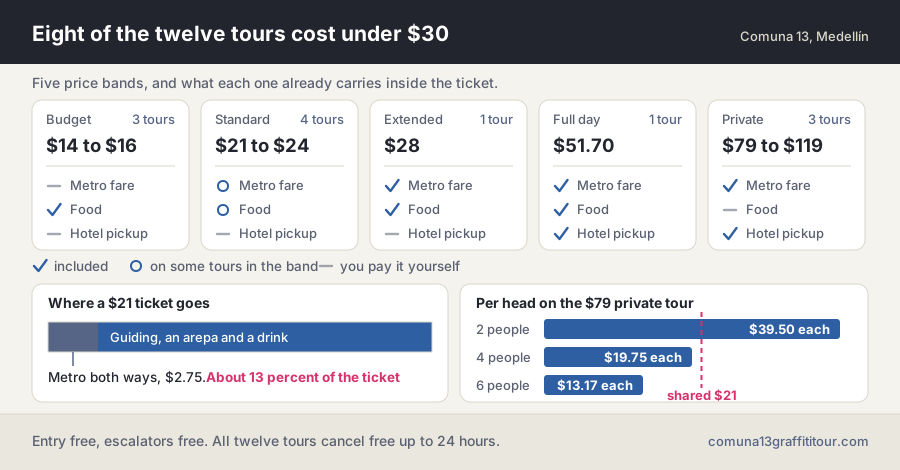
Four bands cover the whole field. At the bottom sit the three-hour walks at $14 to $16, which give you a guide and something to eat and leave your own metro fare outside the ticket. The $21 to $28 band adds transport, a cable-car ride or a hands-on element. Above that you are buying either a whole day or a whole vehicle.
The peso side matters here more than on most destinations, because the currency moved a long way. Through parts of 2025 it traded past 4,000 to the dollar, and by mid-2026 it had strengthened to roughly 3,050 to 3,260. Every conversion on this page uses 3,200 pesos to the dollar, so read the dollar figures as close rather than exact.
Band
Price
What sits in it
Metro fare
Budget walks
$14 to $16
Two to three hours, a guide, snacks, no transport
You pay, about COP 4,400 each way
Standard half day
$21 to $24
Three to four hours, metro and cable car or a workshop
Usually inside the ticket
Extended
$28
Four and a half hours, longest cable-car route, fruit tasting
Inside the ticket
Full day
$51.70
Seven to eight hours, city sights, lunch, hotel pickup
Inside the ticket
Private
$79 to $119
Three to five hours, your party only, car and pickup
Inside the ticket
Two things are true at once in that table. The cheapest options are genuinely cheap, and the price differences between them are smaller than they look once the fare is added back. A $14 walk plus two metro fares lands at about $16.75, which is $4 under a $21 ticket that carries you both ways and feeds you. The full ranking of what each of those tickets buys is in the twelve tours ranked.
What does each tour format cost, one by one?
Twelve tours are bookable. Three sit at $14 to $16, five between $21 and $28, one at $51.70, and three private options at $79, $113 and $119. Every one of them cancels free up to 24 hours before departure, so the price you lock is not a price you are stuck with.
Sorted by price rather than by quality, so you can find your budget and read across.
From
The tour, in one line
Duration
Rating
Reviews
$14
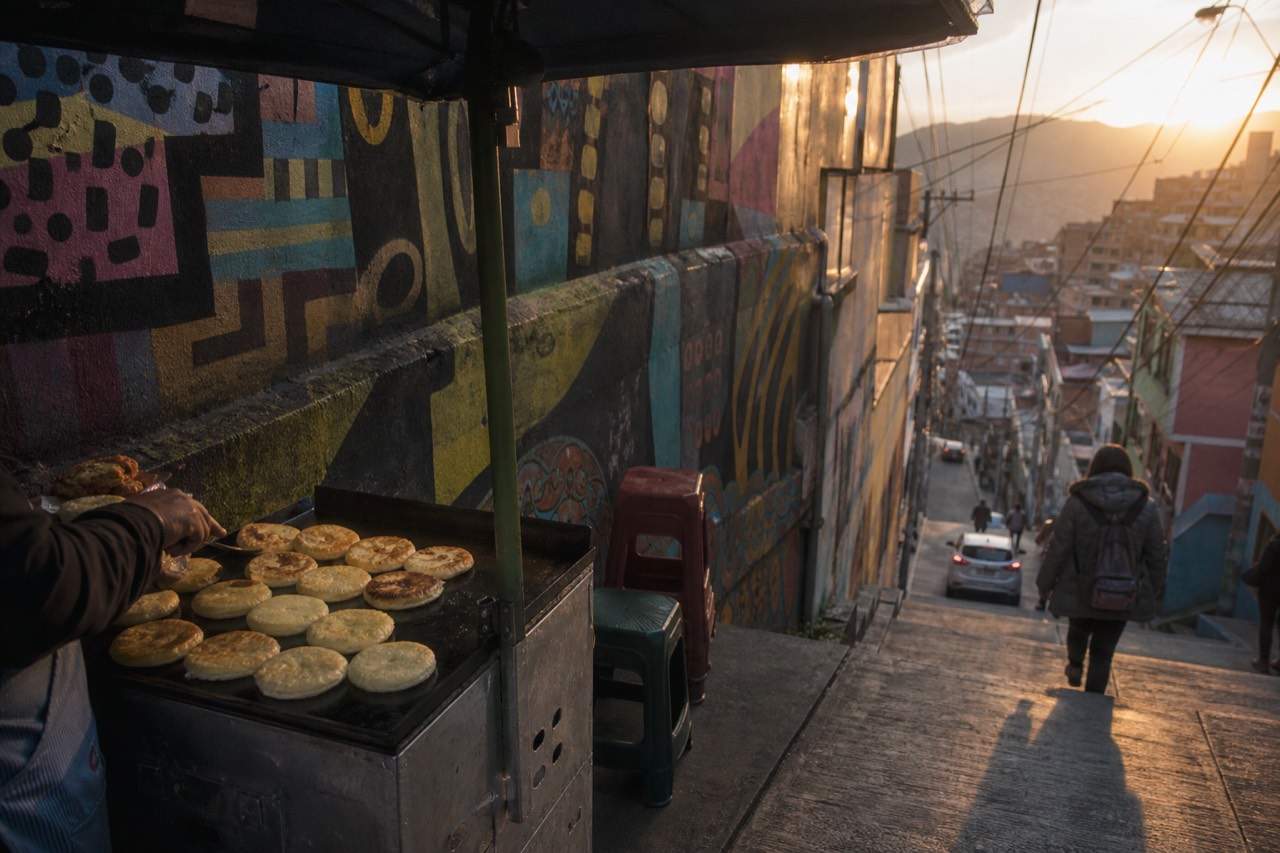
The True Story walk, snacks and street performances
3 h
4.9
2,313
$15
Street art with a barrio-born guide, tiny group
2 to 3 h
5.0
55
$16
Small-group graffitour with snacks, capped at 15
2 to 3 h
4.9
698
$21
Cable-car and street-food flagship, metro included
3 to 4 h
4.8
10,683
$21
Five food stops on foot, large shared groups
3 h
4.9
9,044
$22
District tour built around the cable car
3 to 4 h
4.7
1,541
$24
History, snack and hands-on graffiti workshop
about 4 h
5.0
502
$28
Longest cable-car route with a fruit tasting
4.5 h
4.8
696
$51.70
Paisa for a Day: city tour, barrio, lunch, pickup
7 to 8 h
4.9
1,915
$79
Private metrocable tour, step-free, pickup
3 h
5.0
23
$113
Private car, barrio plus Escobar-era history
4 to 5 h
4.9
258
$119
Private Escobar route with the barrio and transport
5 h
4.8
47
The shape of that ladder is unusual for a tourist neighbourhood. Eight of the twelve options cost less than thirty dollars, and the two with the deepest review histories are both $21. There is no premium tier in the middle, no $60 signature experience. You either buy a shared half day for the price of a restaurant starter or you buy the whole vehicle.
Prices move with the date. Weekend departures, Colombian holidays and the last seats on a nearly full morning all push the starting figure up, so treat every number here as a floor. The one figure that does not move is the cancellation window, which is 24 hours across the board.
What does $25 actually buy?
At the $21 to $25 mark you get three to four hours of guiding, a round-trip metro fare worth about COP 8,800, one arepa and a drink, and on the workshop, spray cans and wall time. Strip out the transport and the food and the guiding itself works out near $4 an hour.
This is the arithmetic almost nobody publishes, so here it is in full. Take the $21 flagship, which is the most-booked ticket in the field.
Line item on a $21 ticket
What it is worth
Notes
Metro, both directions
about $2.75
COP 4,400 a ride, COP 3,820 with a Cívica card
Line J cable car
$0 extra
One integrated fare already covers the transfer
Escalator access
$0
Six sections, free, running about sixteen hours a day
Entry to the neighbourhood
$0
No entry fee and no tourist tax
Arepa and a drink
your own spend, saved
A snack rather than a meal
Three to four hours of guiding
the remainder
Roughly $4 to $5 an hour
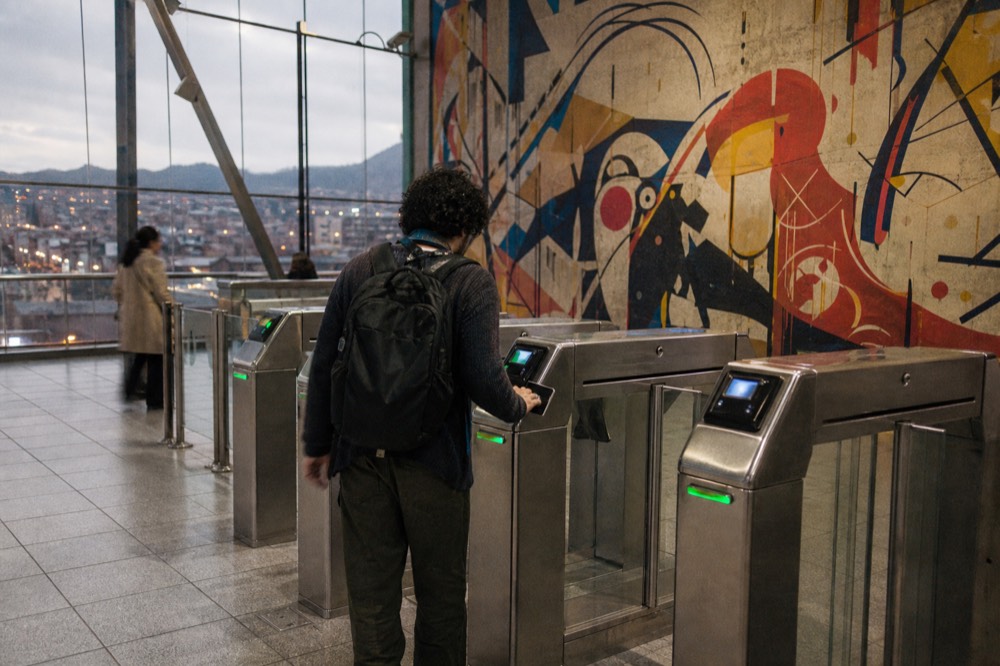
The line that surprises people is the cable car. Listings sell "cable car included" as a headline inclusion, and it is a wonderful thirty minutes, but it costs the operator nothing extra: Medellín's metro integrates Line J with the rest of the network, so the same COP 4,400 that carries you to San Javier carries you up to La Aurora and back. When you pay more for a cable-car tour, you are paying for time and route, not for a ticket.
The $24 workshop is the one place the material cost genuinely rises. Spray paint, a wall, and an instructor who stays with you while you use both. Four hours at that price, rated 5.0 across 502 people, is the strongest value-per-dollar case in the field for anyone who wants to do something rather than look at something.
What does it cost to visit Comuna 13 without a tour?
About COP 8,800, or $2.75, for the round-trip metro, plus whatever you eat. Nothing else on the hill charges. That makes the true premium for the cheapest guided walk roughly $11 per person, and about $18 for the all-in flagship with transport and a snack inside it.
Independent visits work here. The corridor is heavily walked and policed in daylight, the escalators are public infrastructure, and Line B terminates at San Javier so the route is difficult to get wrong. What you lose is context, and context is the entire product.
Line item
On your own
$14 guided walk
$21 flagship
Metro, round trip
COP 8,800, about $2.75
You pay it, about $2.75
Inside the ticket
Cable car
Same fare, no extra
You arrange it
Inside the ticket
Escalators
Free
Free
Free
Snack and a drink
Your own spend
Snacks included
Arepa and drink included
Guide and history
None
3 hours
3 to 4 hours
Realistic total per person
about $2.75 plus food
about $16.75
$21
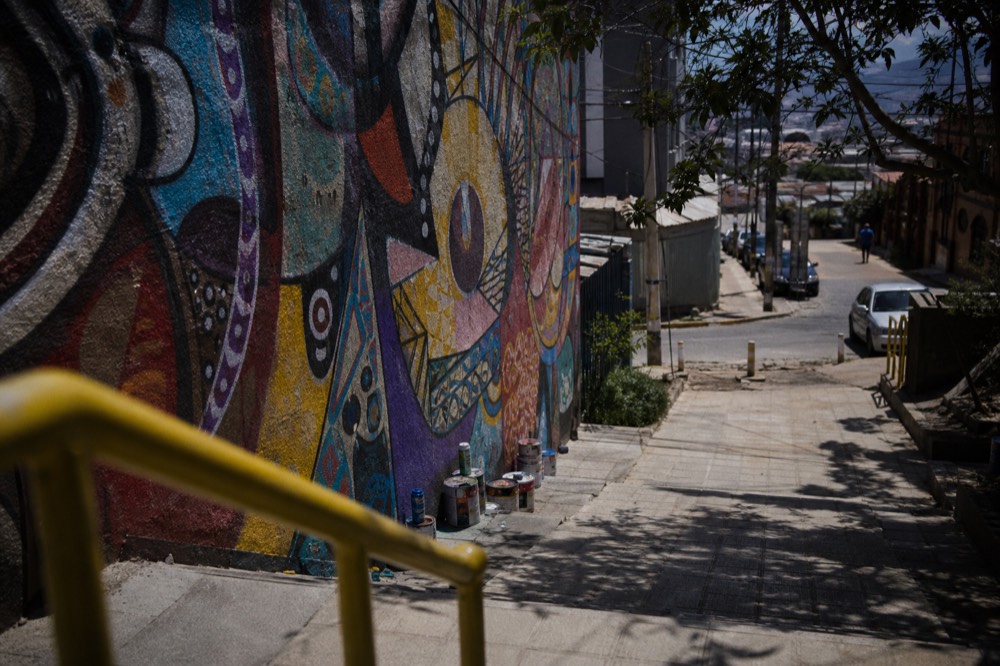
Eleven dollars is a small amount of money for the difference between looking at painted walls and understanding why they are painted. The murals on this hillside are a response to specific events, above all the October 2002 military operation that reshaped the neighbourhood, and without someone to point at the right wall at the right moment most of that goes past you. If you would rather do it alone anyway, the independent route sets out the practical version, and the metro directions to San Javier cover the fare and the transfer.
A Cívica card trims the fare to about COP 3,820 a ride, roughly $1.19, which saves a couple of thousand pesos across a return trip. For a single visit that saving does not justify the queue to get the card. For a week in the city it does.
Are the free walking tours really free?
No, and they do not pretend to be. Tip-based walks run daily and the working norm is 20,000 to 30,000 pesos per person, about $6.25 to $9.40, with 50,000 for a guide who earns it. Add your own metro fare and a free tour lands between $9 and $18 all in.
The free-tour model is strong in Medellín and heavily used in this neighbourhood. Marketplaces including GuruWalk's Medellín listings carry several Comuna 13 walks with long review histories and daily departures. Nothing about them is second-rate.
Tip level
Per person
A couple
Group of four
COP 20,000, the floor
about $6.25
$12.50
$25
COP 25,000, the common figure
about $7.80
$15.60
$31.20
COP 30,000, the upper norm
about $9.40
$18.80
$37.50
COP 50,000, for an outstanding guide
about $15.60
$31.20
$62.50
Plus your own metro fare
about $2.75
$5.50
$11
Run the middle row and the picture clears up fast. A couple tipping the standard COP 25,000 each and paying their own fares spends about $21.10, which is a dollar more than two $14 tickets minus the fares, and close to the price of one $21 all-inclusive seat. Free tours are not the budget option they appear to be. They are a different social contract: no seat guarantee, variable group size, and the awkward moment at the end where you decide what the last two hours were worth in cash you may not be carrying.
Two practical costs get missed. Free walks tend to run larger, especially on Sundays when the barrio is at its busiest, and tipping requires small pesos rather than a card. If either of those bothers you, a $14 or $16 booked ticket removes both problems for a few dollars. The full side-by-side is in what the free walks really cost.
What is each inclusion actually worth?
Transport is worth about $2.75, food is worth whatever you would have spent anyway, and the cable car is worth nothing extra because the fare is integrated. Everything else on the price tag is guiding, group size and pace. Hotel pickup is the only inclusion that reliably justifies a large jump.
Listings compete on inclusion lists, and inclusion lists are where price comparisons go wrong. Below is what each commonly advertised line actually adds in hard cost.
Advertised inclusion
Real added cost
Worth paying for?
Metro ride included
about $2.75 return
Yes, mainly for the convenience
Cable car included
$0, same integrated fare
Only for the route and the time it takes
Snacks or an arepa
A few dollars of street food
Marginal, unless there are five stops
Five food stops
A light lunch, genuinely
Yes, this replaces a meal
Hotel pickup
Real vehicle and driver time
Yes, it removes an hour of logistics
Small group cap
Nothing material, just fewer seats sold
Yes, this is the biggest quality lever
Spray paint and wall time
Materials and instruction
Yes, on the $24 workshop
Escalator access
$0, they are public and free
Never pay a premium for this
Group size is the one to spend on. It costs an operator almost nothing to cap a walk at 15 instead of 40, and it changes the experience more than any other line on the list. That the 15-cap graffitour costs $16 and the 40-cap food walk costs $21 tells you the market has not priced this the way experience would suggest. The food-led options are compared on the food walks hub, and you can see what the $14 walk covers on your date if you want the cheapest version with snacks already inside it.
The one most people book, and the reason is the route: metro from Poblado, the Line J cable car over the rooftops, then the murals on foot with an arepa in one hand and a drink at a viewpoint bar at the end. Transit tickets are already in the price, so the day runs itself.
The budget private option: your own vehicle and driver-guide, hotel pickup, and every metro, cable and toll fee handled. Wheelchair and stroller accessible, which almost nothing else in the barrio's steep alleys can claim.
At four people and up. The $79 private metrocable tour divides to $19.75 a head across four and $13.20 across six, which undercuts every shared ticket in the field. The $113 and $119 private history tours need six or more before they compete, and even then you are buying privacy rather than savings.
Private pricing here is per group, not per seat, so the headline number is misleading in both directions. It looks expensive for two people and it is. It looks expensive for six and it is not.
Group size
$79 metrocable tour
$113 history tour
$119 Escobar route
2
$39.50 each
$56.50 each
$59.50 each
3
$26.33 each
$37.67 each
$39.67 each
4
$19.75 each
$28.25 each
$29.75 each
5
$15.80 each
$22.60 each
$23.80 each
6
$13.17 each
$18.83 each
$19.83 each
8
$9.88 each
$14.13 each
$14.88 each
Read the four-person row against the shared ladder. At $19.75 each, the private metrocable tour costs less than the $21 flagship and comes with hotel pickup and a step-free route. That is the clearest pricing anomaly on this page, and it exists because most people booking privately are couples, so the group rate never gets tested at size.
The two history tours are a different calculation. At six people they land near $19 a head, which is competitive, but you are paying for a car, a pickup and a route that spends part of its time on Escobar-era sites rather than on the neighbourhood's own story. Whether that is the right trade depends on what you came for. The formats are compared on what private booking buys you, and the day-long alternatives sit on the full-day city combinations.
What should you budget for the whole half day?
Budget $25 to $35 per person for a complete shared morning: the tour, your own fare if it is not included, a drink at a viewpoint, tips and something small to carry home. Doing it independently, $10 to $15 covers the same day without a guide.
The tour is rarely the whole spend, but here it is close, because the neighbourhood charges nothing for the things people normally pay for.
Start from the ticket, somewhere between $14 and $28 for a shared morning, and add your own round-trip fare of about COP 8,800 if it is not already inside it. Then the free half of the day: the escalators, the viewpoints, the walk itself and entry to the neighbourhood all cost nothing, which is why the totals here stay so low compared with a comparable half day almost anywhere else in the region. What remains is discretionary. A drink on a terrace, a tip if the guide was good, and the one line most people are glad they budgeted for, which is a print or a sticker or a small piece of work bought directly from the person who made it.
Carry small notes. Card acceptance climbs every year in Medellín, but the terrace kiosks, the artists selling prints and the tip at the end of a walk all run smoother in cash, and an ATM run in the middle of a tour wastes twenty minutes of a three-hour morning.
One last budgeting note about timing rather than money. Medellín's year-round climate holds around 19 to 22°C in every month, so nothing about the calendar affects what you wear. Rain is the variable. Afternoon showers are common between April and May and again through October and November, with May the wettest month at roughly 268 mm against January's 112 mm. A morning tour protects the day, and since every option cancels free up to 24 hours out, holding a morning slot early costs nothing. If you are still deciding whether the half day earns its place at all, who this visit actually suits answers that plainly, and every bookable tour compared side by side sits on the home page with live prices.
Eight of the twelve tours cost under $30, and transport is only about 13 percent of a $21 ticket.
Frequently asked questions
How much does a Comuna 13 tour cost?
Guided tours start at $14 for a three-hour walk with snacks and reach $119 for a five-hour private route with a car and hotel pickup. Most shared options sit between $14 and $28. The full-day city combination with lunch is $51.70, and the cheapest private tour is $79 for the whole party.
Is there an entry fee for Comuna 13?
No. There is no entry fee and no tourist tax for the neighbourhood, and the six sections of outdoor escalator are free public infrastructure running about sixteen hours a day. The only unavoidable cost of visiting independently is the metro fare, roughly COP 4,400 each way.
How much should I tip on a free Comuna 13 walking tour?
Between 20,000 and 30,000 pesos per person, about $6.25 to $9.40, with 25,000 the figure most commonly cited as standard. Up to 50,000 is normal for a guide who genuinely earned it. Bring small notes, since tips are cash in practice and the moment arrives at the end of the walk.
Is a Comuna 13 tour cheaper than going on your own?
No, but the gap is small. Independently you pay about COP 8,800 round trip on the metro, roughly $2.75, plus whatever you eat, because everything else on the hill is free. The cheapest guided walk adds about $11 per person for three hours of context you cannot get from the walls themselves.
When is a private Comuna 13 tour worth the money?
From four people upward. The $79 private metrocable tour works out at $19.75 each across four, below the $21 shared flagship, and includes hotel pickup and a step-free route. The $113 and $119 history tours need six or more before the per-head figure competes with a shared ticket.
Do Comuna 13 tour prices change by date?
Yes. Every figure quoted is a starting price, and weekends, Colombian holidays and nearly full departures push it up. Sunday is the busiest day in the barrio, which affects both price and group size. All twelve tours cancel free up to 24 hours ahead, so booking a morning early costs nothing to change.
See what the $14 walk covers
Three hours, snacks and street performances, rated 4.9 across 2,313 travellers, with free cancellation up to 24 hours. Check the current price on your date.