The Comuna 13 Escalators: History, Hours and How to Ride Them
Six flights of outdoor escalators bolted to a hillside, about 384 metres of them, free at the point of use. They exist because the alternative was several hundred concrete steps carrying groceries.
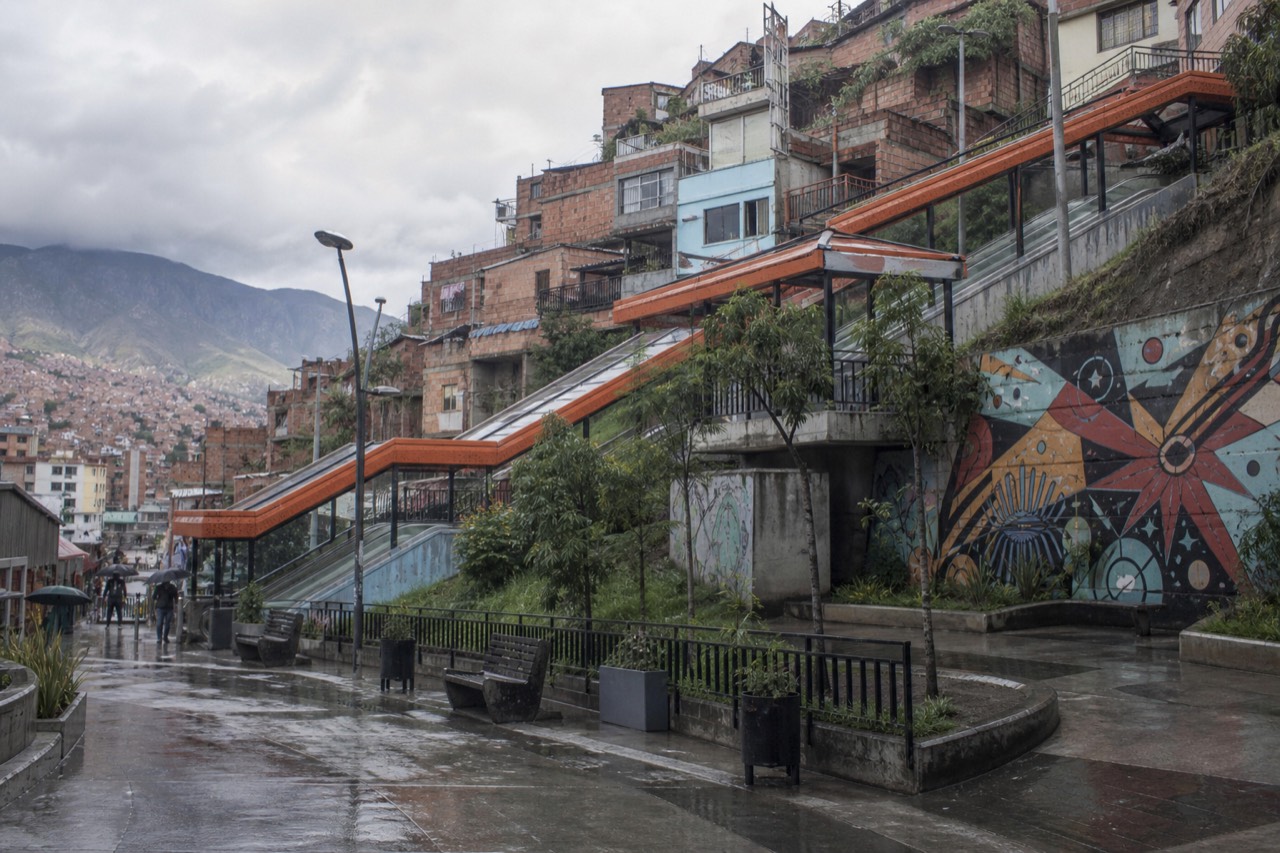
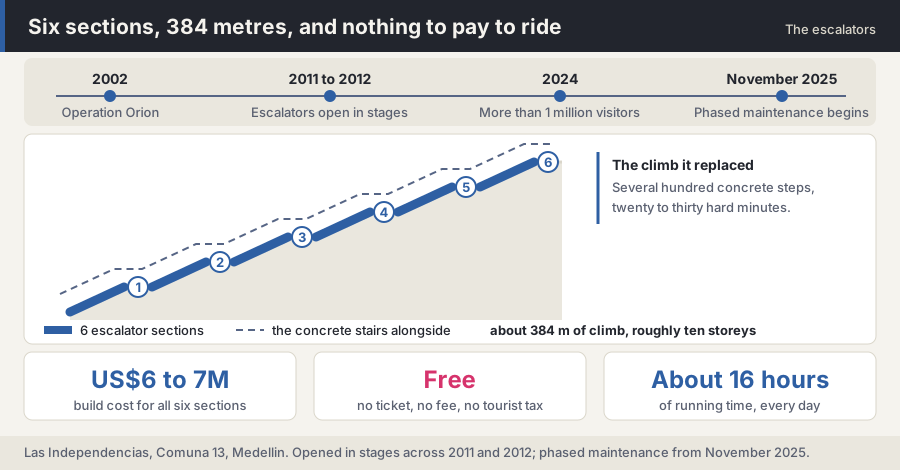
The Comuna 13 escalators are six linked sections of covered outdoor escalator, roughly 384 metres in total, climbing the Las Independencias hillside. They opened in stages across 2011 and 2012 at a cost of about US$6 to 7 million, replacing a stairway of several hundred steps. They are free to ride and run around 16 hours a day.
Stand at the bottom flight on a Tuesday morning and the traffic on the escalators is not tourists. It is a woman with two bags of shopping, a man carrying a length of pipe, three kids in school uniform, and a delivery rider who has parked his motorbike below because the street runs out. The visitors arrive later, mostly after ten. The escalators were never built for them.
That is the fact everything else on this page hangs from. Six sections of covered outdoor escalator, about 384 metres of them, climbing a slope of stacked brick houses in the Las Independencias sector. They cost somewhere in the region of six to seven million dollars, they opened in stages across 2011 and 2012, and they were a piece of public transport policy aimed at people who had spent their whole lives climbing several hundred concrete steps to get home.
They also happen to be one of the more photographed pieces of infrastructure in South America, which is a separate story and a much shorter one.
What are the Comuna 13 escalators?
They are six linked sections of covered outdoor escalator, formally the Sendero de Conexión Independencias I, running up the hillside in the Las Independencias barrio of Comuna 13, Medellín. Total length is reported at about 384 metres. They are public infrastructure, free to use, and they replaced a concrete stairway of several hundred steps.
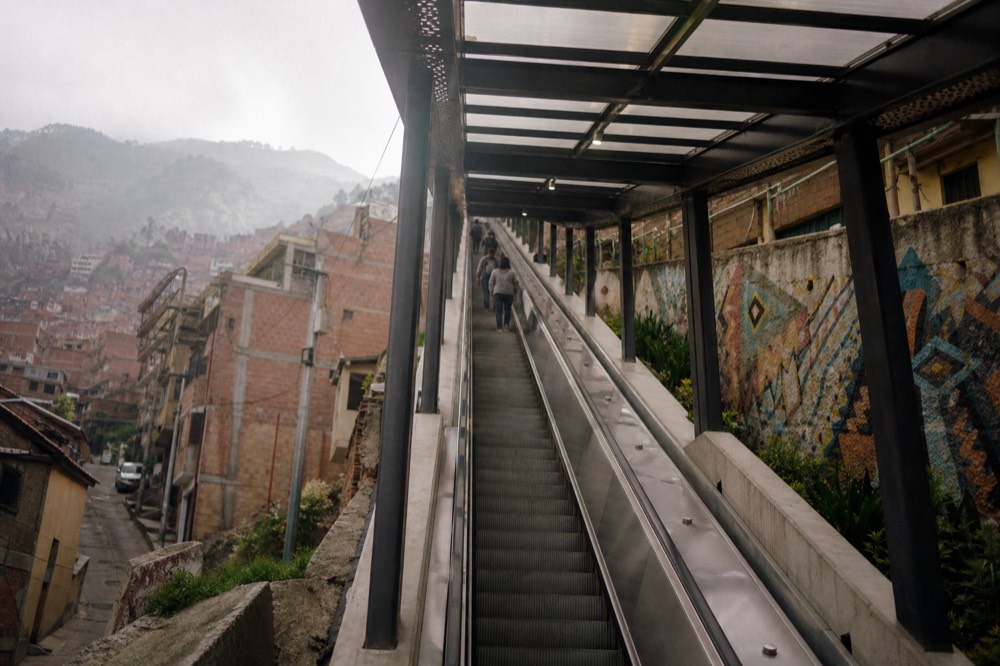
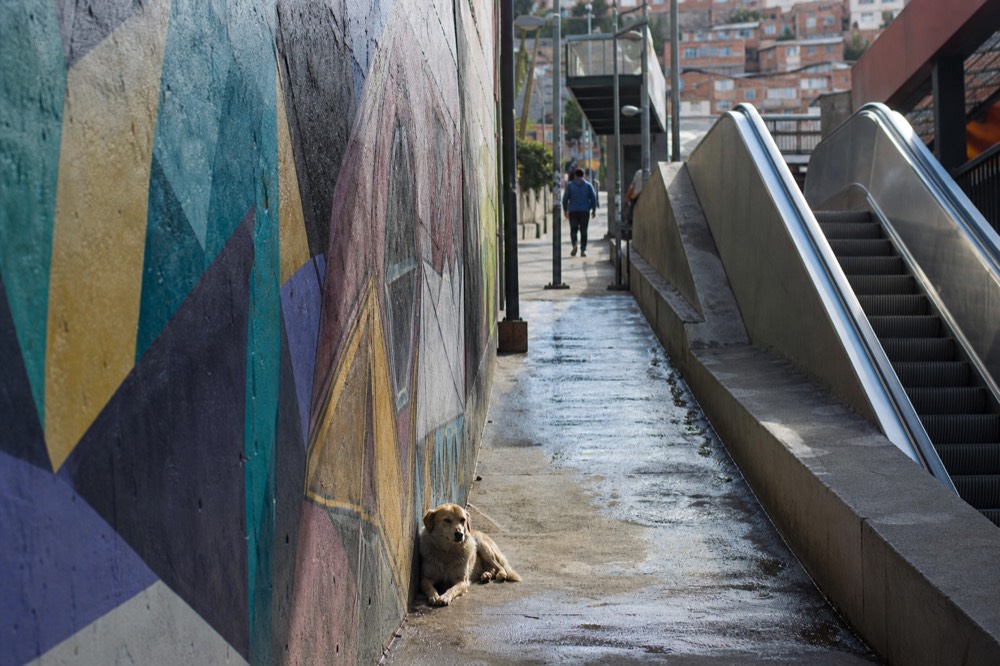
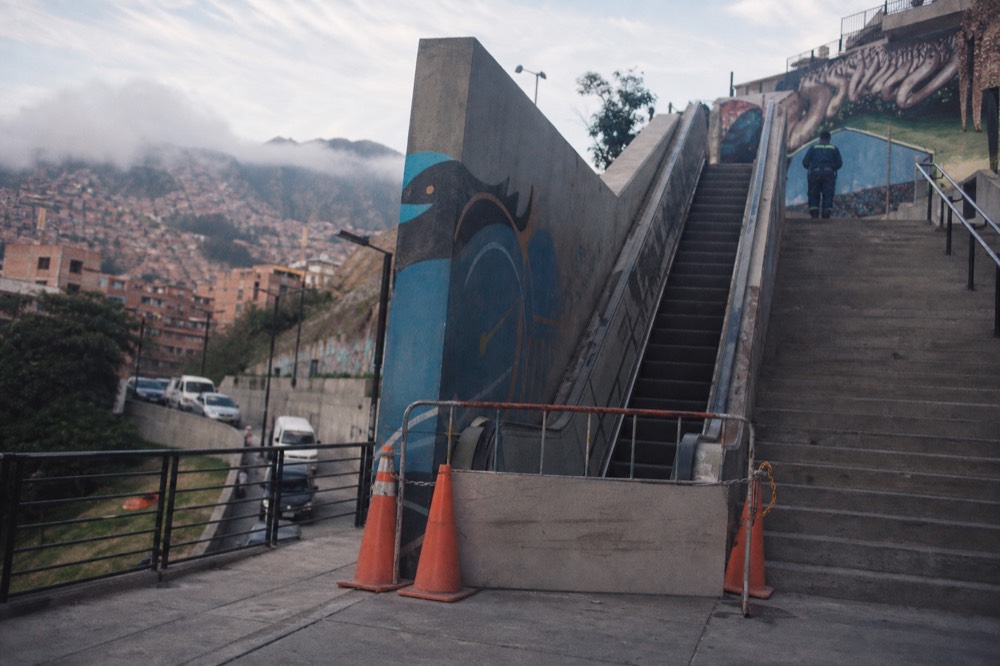
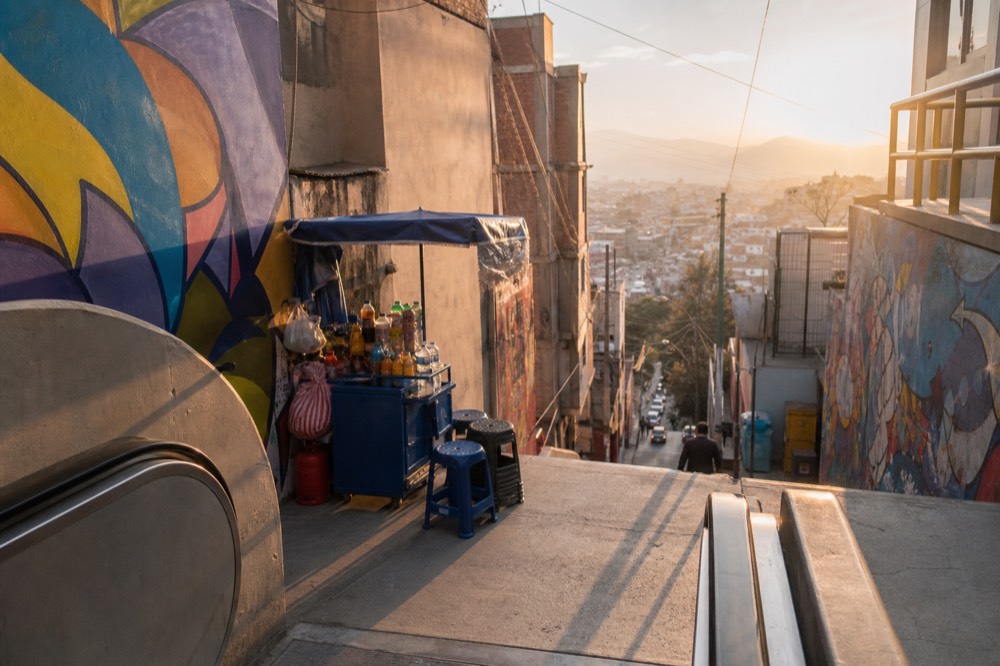
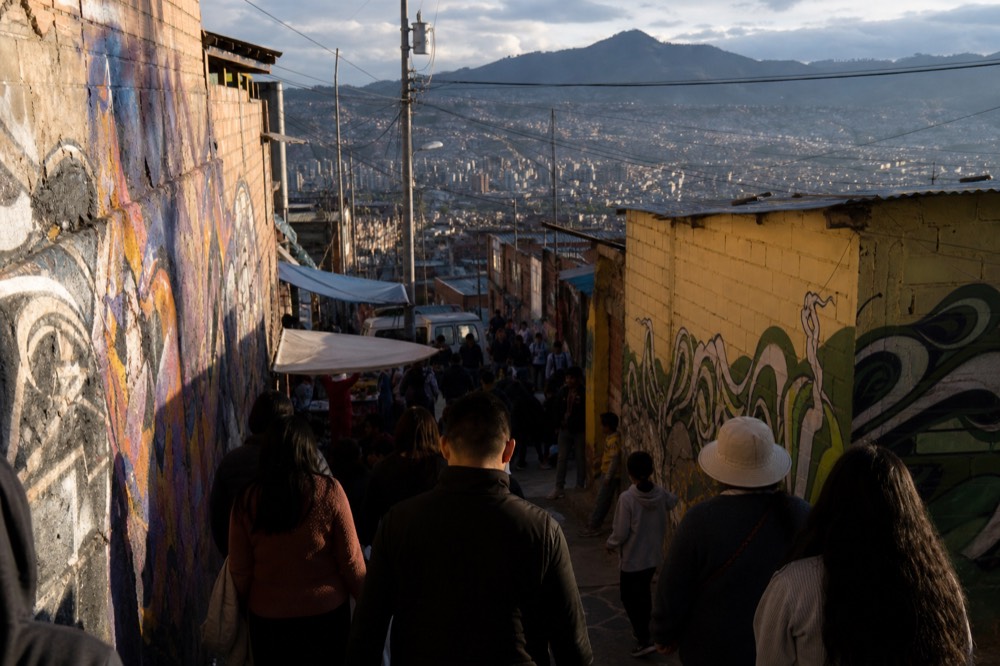
The word escalator does a lot of quiet work here. These are not one long moving stair. They are six separate double-escalator runs, each set into the slope at its own angle, joined by concrete landings where the hillside forces a change of direction. You ride, you step off, you walk a few metres across a landing, you ride again. The landings are where the neighbourhood happens: stalls, painted walls, dogs, people sitting.
The overall climb is steep enough that older descriptions put it at roughly ten storeys of vertical rise. That is the number that makes sense of the whole project. Ten storeys is a lot of building to walk up carrying anything, and residents at the top of Las Independencias were doing it several times a day, in the heat, in the rain, at seventy years old.
Fact
Figure
Sections
6 double-escalator runs
Total length
about 384 metres
Vertical rise
described as roughly a ten-storey climb
What it replaced
a concrete stairway of several hundred steps
Opened
in stages across 2011 and 2012, operations from May 2012
Build cost
about US$6 to 7 million
Cost to ride
free
Daily operating window
around 16 hours
Location
Las Independencias sector, Comuna 13, western slope
Entry fee for the neighbourhood
none
Everything in that table is infrastructure, not attraction. There is no ticket office, no turnstile, no queue system and nobody official collecting anything at the bottom. If somebody tells you otherwise on the walk up, they are freelancing.
Why did the city build escalators on a hillside?
Because the hillside was the barrier. Las Independencias sits high on a steep western slope with no road access to its upper reaches, and the only way in and out was a long concrete stairway. The escalators were a mobility project first: cut a punishing daily climb to a few minutes and you change who can work, study and get medical care.
Medellín spent the 2000s and 2010s building transport into the parts of the city that transport had never reached. Cable cars strung over the ravines, library parks planted in the barrios that had the least, and, in Comuna 13, an escalator up a slope too steep for a bus. The label people use for it is social urbanism, and whatever you think of the branding, the engineering logic is plain: geography was doing the excluding, so the city attacked the geography.
The timing was not accidental either. Comuna 13 had been through the worst decade of any neighbourhood in the city, and October 2002 brought Operation Orion, the largest urban military operation in Colombia's recent history, into these streets. The escalators arrived less than a decade later into a place still counting what that had cost it. Reading them purely as a transport upgrade misses half the point, and reading them purely as a symbol misses the other half. The background to Operation Orion is the context most visitors arrive without.
What the escalators did not do is fix everything, and the barrio is fairly direct about that. Exhumations at La Escombrera, the site linked to the disappeared, have continued in recent years, which tells you the accounting is not finished. How the neighbourhood got from 2002 to here is the full version of that story.
How big are they, and what did they actually replace?
About 384 metres across six sections, standing in for a stairway reported at several hundred concrete steps. Where the climb used to take a resident somewhere between twenty and thirty hard minutes, the escalators reduce it to a ride of a few minutes with your hands free. The old stairs still exist alongside, and they still get used.
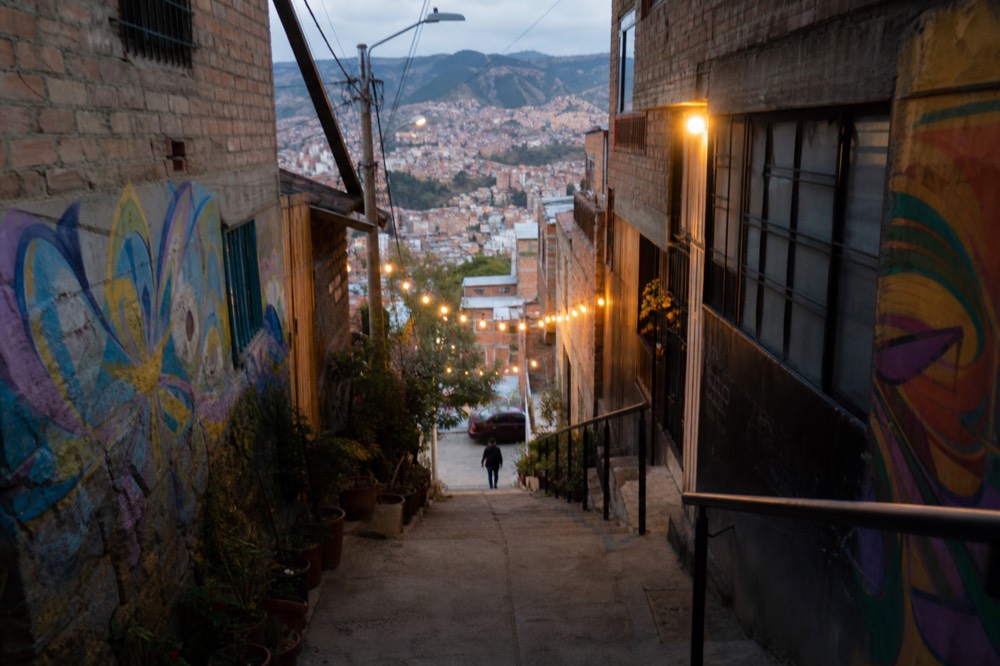
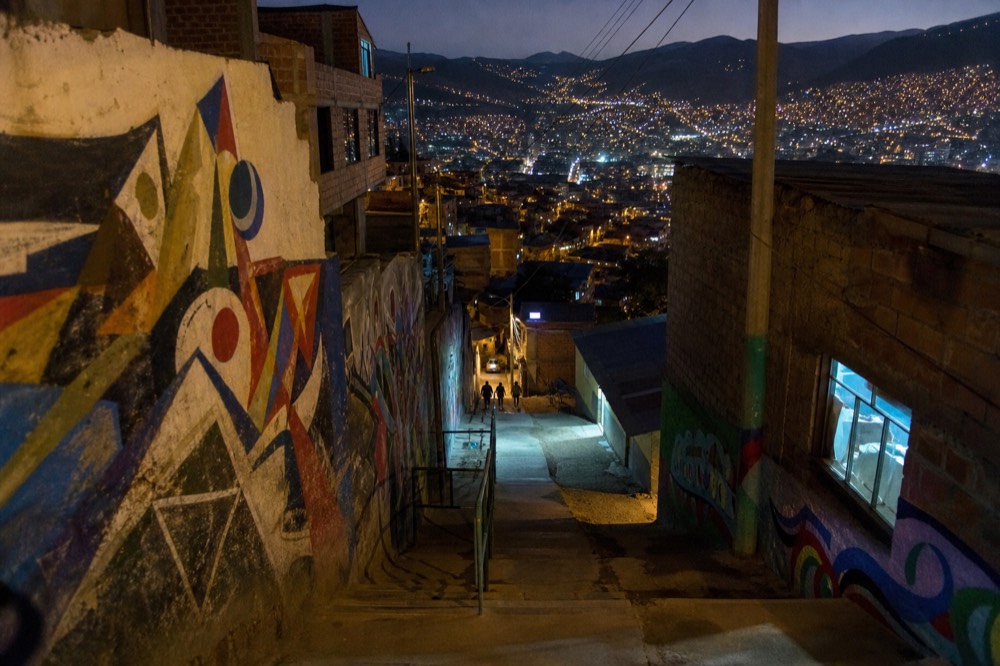
The stairs beside the escalators are the underrated part of a visit. They are the original route, worn, steep, lined with front doors and washing lines, and they run parallel the whole way. When a section is out of service, the stairs take the load. When the escalators shut for the night, the stairs are the neighbourhood.
Way up the slope
What it covers
Cost
Effort
Available
The six escalator sections
The Las Independencias climb, about 384 m
Free
Almost none, plus short landings
Around 16 hours a day
The concrete stairs beside them
The same climb, the original route
Free
Hard, several hundred steps
Always, including maintenance closures
Local minibus from the station
Station plaza up to the barrio, not the escalator climb
A few thousand pesos, cash
None
Daytime, cash only
Line J cable car
San Javier up the western slope for the view
Inside one integrated metro fare
None
Typically from mid-morning
Walking up from San Javier station
Station to the barrio, before the escalators start
Free
Steady 20 to 30 minute climb
Always
Two of those rows are doing different jobs and people confuse them constantly. The cable car and the minibus get you from the metro to the neighbourhood. The escalators get you up through the neighbourhood once you are there. They are consecutive, not alternatives, and the full route in from the metro sets out how the legs fit together.
What did the escalators cost to build?
Reported at roughly US$6 to 7 million for the six sections, funded and delivered as a municipal public works project. Riders pay nothing. Set against a city budget that number is small, and against the daily lives of the households above it, it was one of the better-value pieces of infrastructure Medellín has built.
The cost figure is worth sitting with because it reframes the whole thing. Six or seven million dollars is a rounding error next to a metro line, a bridge or a stadium. It bought a permanent change in access for thousands of households, and it did so by treating a steep hill as a public transport problem rather than a housing problem.
The running costs are the part nobody puts on a plaque. Outdoor escalators on a tropical hillside live a hard life: rain, dust, grit, heavy footfall, sixteen hours a day, every day, for well over a decade now. Motors wear. Steps wear. Handrails wear. That is precisely why the maintenance programme covered further down this page exists, and why any given visit might meet a section that is switched off.
There is no ticket revenue to cover any of that. It is a free public asset paid for out of the city, which is the same arrangement as a pavement or a set of traffic lights, and worth remembering when a visitor complains that a flight is out of service.
Are the escalators free, and what hours do they run?
Free, with no ticket, no fee and no tourist charge anywhere in the neighbourhood. They operate around 16 hours a day, so realistically from early morning to late evening, though the exact window is set by the city rather than published like a train timetable. There is no reservation system and no capacity limit.
Sixteen hours is a generous window and it means the escalators are almost never the thing that constrains your visit. What constrains your visit is everything else: the crowd, the heat, the rain and the cable-car hours if you are riding one.
Practicality
The answer
Ticket or entry fee
None, for the escalators or the neighbourhood
Operating window
around 16 hours daily
Booking
Not possible and not needed
Best arrival time
Mid-morning, before the corridor fills
Busiest day
Sunday, by a clear margin
Payment on site
Cash pesos for drinks, snacks and stalls
Footwear
Grip matters, the landings and stairs get slick in rain
Accessibility
Escalators help, but landings and side streets are still steps
Toilets
Cafes and small businesses along the corridor, small charge sometimes
Photography
Fine in general, ask before photographing residents
The accessibility line is the one that needs honesty rather than a tick. Six escalator sections remove most of the vertical work, and that is genuinely transformative compared to the stairs. But the corridor around them is a hillside barrio: uneven paving, kerbs, short flights of steps, narrow passages. Anyone using a wheelchair or pushing a stroller should plan the visit around a format built for it rather than assume the escalators solve the whole problem.
Are the escalators closed for maintenance in 2026?
Partly, in rotation. A programme of integral maintenance began in November 2025 and ran into the middle of 2026, taking one section at a time so the rest of the run stays open. The concrete stairs beside the escalators remain available throughout. Sections have been reported back in service through mid-2026 updates.
This is the single most useful thing on this page for anyone visiting in the next few months, and it is also the thing most travel content gets wrong by stating flatly that the escalators are open or closed. Neither is true. They are being worked through in sequence.
Maintenance question
Where it stands
Programme start
November 2025
Approach
One section at a time, sequential and partial
Extent
Ran into mid-2026
Alternative while a section is down
The concrete stairs beside it, kept open
Whole-run closure
Not the approach taken
Status through mid-2026
Sections reported operational again
Where announcements appear
City hall communications
Effect on tours
Guides reroute onto the stairs for the affected flight
The practical read: assume you will ride most of the sections and might walk one. Guides working the corridor daily know which flight is down that week and simply take the stairs for that stretch, which is why a guided walk absorbs the disruption better than a solo visit does. Maintenance notices and works announcements are posted by the city government of Medellín, which is the only source worth trusting on this rather than a blog post written two years ago.
If your visit falls inside one of these windows, nothing about it is ruined. You climb one flight of stairs that the residents climb every day, which is arguably a more honest version of the experience than gliding past on a motor.
What changed in the barrio after they opened?
Access first: households at the top of the slope stopped losing half an hour a day to a stairway. Then attention, which brought the graffiti and hip-hop culture growing here through the 2010s into contact with an outside audience. By 2024 the corridor was taking more than a million visitors a year and had become the most-visited place in Medellín.
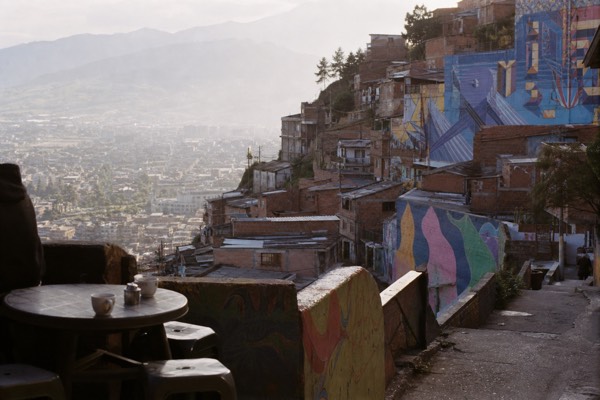
The cultural half of the change was not built by the city. Through the 2010s a hip-hop and graffiti scene grew out of the barrio itself, organised around community houses and collectives, and the guided walk format that visitors now book grew directly out of that movement rather than being imported into it. That is why the tours here feel different from a generic city walk: the people running many of them are from the streets they are describing, and quite a few of them painted the walls.
Period
What happened
October 2002
Operation Orion, the largest urban military operation in recent Colombian history
Late 2000s
City invests in transport into the western slope, cable and pedestrian infrastructure
2011 to 2012
The six escalator sections open in stages, operations from May 2012
Through the 2010s
Hip-hop and graffiti culture organise, community-led walking tours take shape
Recent years
Exhumations continue at La Escombrera, the accounting unfinished
2024
More than a million visitors to the corridor, the city's most-visited site
November 2025 onward
Phased maintenance of the escalator sections begins
There is a cost column to that table that the numbers do not show. A million visitors a year through a residential hillside puts real strain on a place that has narrow streets, limited services and people trying to live normally. Reports of over-capacity through 2025 and 2026 are not tourist grumbling about queues, they are about a neighbourhood absorbing more footfall than its infrastructure was sized for. Visiting well means moving through respectfully, spending money locally, and not treating somebody's front doorstep as a photo backdrop. Whether the visit is worth making at all is a fair question, and the honest answer depends a lot on how you do it.
What is riding them actually like?
Slower and steeper than the photographs suggest. Each section is short, the landings break the rhythm, and the view opens progressively rather than all at once. Expect ten to twenty minutes to get from the bottom to the top terraces with normal stopping, and considerably longer if you are with a group that photographs everything.
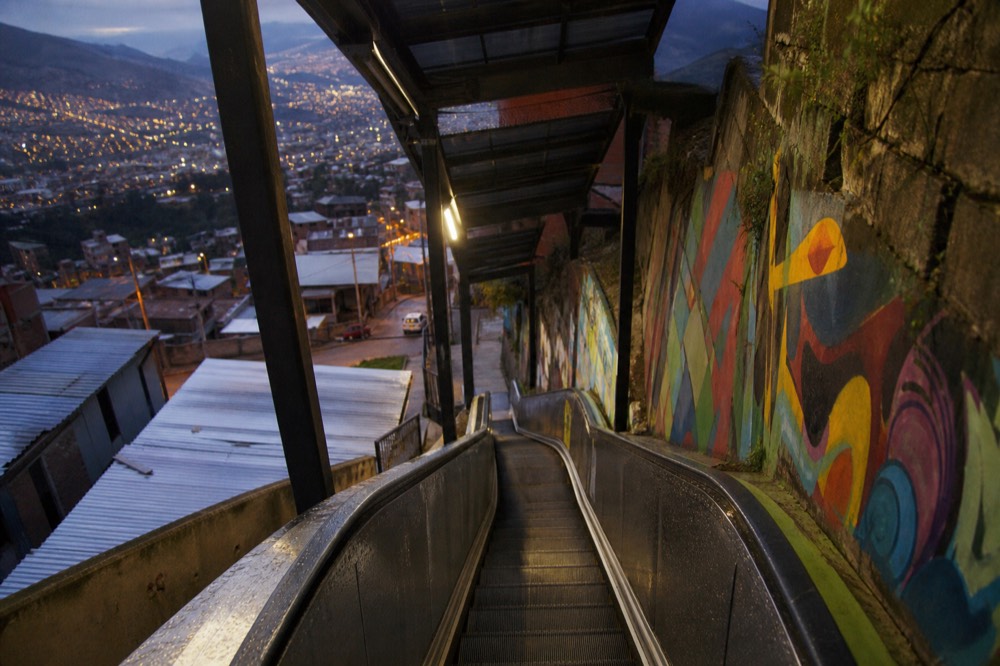
The first flight is unremarkable and slightly disappointing. Then you step off onto the first landing, turn, and the valley starts appearing between the houses. By the third or fourth section you are above the roofline of most of the barrio and can see the whole western slope falling away below, with the city floor in the haze beyond it. That progressive reveal is the actual experience, and it is why people who have ridden a shopping-centre escalator still find this one strange.
Rain changes it completely. The canopies keep the escalators running but the landings get slick, the murals go saturated and dark, the terraces empty, and the whole corridor takes on a quieter, more domestic feel. Some visitors prefer it. Everyone agrees it is a bad time to be wearing smooth-soled shoes.
Crowding changes it too, in the other direction. On a Sunday afternoon the landings compress, the escalators develop a queue at the transitions, and the stalls run three deep. Morning on a weekday is a different neighbourhood entirely, and the best hours and days to arrive is worth two minutes before you set an alarm.
Six sections, 384 metres, free: what the hillside looked like before and after.
Do you need a tour to ride the escalators?
No. They are public infrastructure with no ticket and no gate, and plenty of people ride them independently. What a guide buys you is the reading: which wall says what, why a section of stairs is still there, who the community houses belong to, and what happened on the street you are standing on. Walks here start around $14.
The independent version works. Get to San Javier, get up to the barrio, ride the sections, buy a mango on a landing, look at the view, come back down. Nobody will stop you and nothing will be closed to you. If that is your instinct, going up without a guide sets out the route and the etiquette properly.
What you lose alone is context, and in this particular neighbourhood context is most of the value. The walls are not decoration. They are a record of a decade nobody here has finished processing, painted by people with names and reasons, and without someone to point at them you are looking at colour.
If you want
The format
From
Group
The full route with cable car and street food
Most-booked walk, 4.8 across 10,683 reviews
$21
Standard group
The cheapest way in with a guide
True Story walk, 4.9 across 2,313 reviews
$14
Standard group
A small group and a barrio-born guide
Local guide walk, 5.0 across 55 reviews
$15
Tiny
To paint something yourself
History, snack and graffiti workshop, 5.0 across 502 reviews
$24
Workshop-sized
Five food stops built into the walk
Street-food walk, 4.9 across 9,044 reviews
$21
Up to 40
Step-free handling and hotel pickup
Private walk with the cable car, 5.0 across 23 reviews
$79
Private
The workshop format is the outlier worth flagging. Instead of looking at painted walls for three hours you spend part of the session with a can in your hand making your own piece, which turns a viewing into a doing, and it holds a perfect rating across 502 reviews. You can check what the graffiti workshop includes and which dates are open if that sounds better than another walking tour.
The cheapest way into the barrio with a guide, and the reviews read like it costs triple. Three hours through the escalators and viewpoints with snacks, a mango-lime popsicle, and rap and breakdance shows where the guides let the neighborhood tell its own story.
A quiet, tiny-group walk led by a guide who grew up in the barrio, with an empanada, an artisanal popsicle and coffee along the way. New listing, small review count, perfect scores so far, and the most personal version of the story on this page.
Weekday mornings, ideally between nine and eleven. Sundays are the busiest day of the week and the middle of the afternoon is the worst combination of heat, rain risk and crowd. Take cash in small peso notes, shoes with grip, water, and a phone that lives in a front pocket.
Weather is the other scheduling lever and it works the same way all year. Medellín sits between 19 and 22 degrees in every month, so temperature never really decides anything. Rain does, and it arrives in the afternoon far more often than the morning. That pattern is why almost every organised walk here starts before lunch.
Traveller
Best approach
Why
First-time visitor, no Spanish
Guided walk from around $14 to $21
The context is the product, and the transfers are handled
Confident independent traveller
Metro to San Javier, then up
Cheap, straightforward and safe in daylight
Wheelchair user or stroller
Private format built for step-free handling
Escalators help, the surrounding streets still do not
Family with young children
Morning walk, short format, snacks included
Two to three hours is the realistic attention span
Photographer
Weekday, early, and again at dusk
Empty landings and side light on the hillside
Anyone visiting mid-2026
Check the maintenance picture first
One section may be stairs that week
Two last pieces of etiquette that matter more here than at most sights. People live along this route, so their doorways, windows and washing are not scenery. And the money you spend on the corridor, on a juice, a coffee, a print, a tip for a guide, stays in the barrio in a way that a ticket to somewhere else does not. Free tip-based walks operate here daily, and a working tip runs around 20,000 to 30,000 pesos a person, more for a guide who was genuinely good. If a scheduled walk suits you better than a tip-based one, you can compare the most-booked route and its current dates, or start from the full 12-tour comparison and work down.
Frequently asked questions
How much do the Comuna 13 escalators cost to ride?
Nothing. They are free public infrastructure with no ticket, no gate and no tourist charge, and there is no entry fee for the neighbourhood either. You only need cash for food, drinks, souvenirs and tips along the corridor.
How long are the Comuna 13 escalators?
About 384 metres across six linked double-escalator sections, climbing a slope described in older accounts as roughly a ten-storey rise. They replaced a concrete stairway of several hundred steps, which still runs alongside them and is still in use.
When were the escalators in Comuna 13 built?
They opened in stages across 2011 and 2012, with operations beginning in May 2012. The build cost is reported at roughly US$6 to 7 million, delivered as a municipal public works project rather than a commercial attraction.
Are the Comuna 13 escalators working in 2026?
Mostly. A phased maintenance programme started in November 2025 and ran into mid-2026, taking one section at a time rather than closing the whole run, with the concrete stairs beside each section kept open. Sections have been reported operational again through mid-2026.
What time do the Comuna 13 escalators open?
They run for around 16 hours a day, which in practice covers early morning to late evening. There is no reservation system. The more useful timing question is the crowd: weekday mornings are far quieter than Sunday afternoons.
See the escalators with the story attached
The most-booked walk here climbs the escalator sections with a guide, adds the cable car and finishes with street food. Check what dates are still open.